3,232 AS questions · Physics teaching tools
CAIE 9702 AS Physics Question Bank
Built around everyday lesson preparation, bringing question filters, a selection basket, paper assembly and print settings into one website.
PHYSICS / TEACHING / AI
A force-analysis lesson for students with an IGCSE foundation: uncover a misconception, build a model, then check understanding through independent practice and an exit ticket.
Substituting into F = ma does not by itself show that a student knows which forces belong in the equation. This lesson starts with modelling: choose the object, draw the external forces acting on it, define a positive direction, then write and interpret the equation.
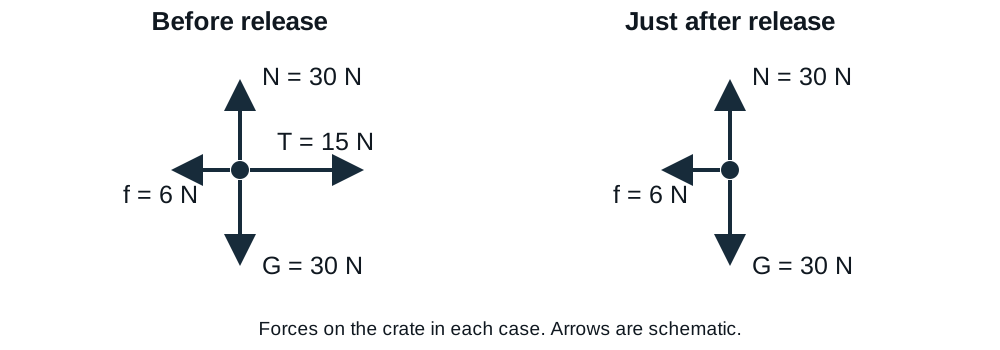
Short questions on constant velocity and third-law pairs lead into a worked crate example. Students then compare the forces before and after a rope is released, apply the model to a suspended load, and attempt an exit ticket independently. The teacher plan specifies when to model, when to step back, and how to use an error to revisit the relevant step.
Ready for classroom trials
Identify the object, external forces and positive direction, then connect the diagram, equation and explanation.
An English worksheet, separate solutions and a Chinese teacher plan preserve the full classroom-practice sequence.
Keep the first response, ask the student to explain a correction, then check transfer with a new exit-ticket situation.
Minutes 0–5 · Two short questions separate constant velocity from resultant force, and balanced forces from a third-law pair. Keep the first response as a starting point for feedback.
Minutes 5–18 · Choose one object, identify its external forces and set a positive direction. A pulled crate connects the diagram, the equation and the direction of acceleration.
Minutes 18–45 · Students work independently on a released rope and a suspended load, explain a correction, then use a new exit-ticket situation to check transfer.
Materials have been prepared and checked; classroom trials are still pending. This is a teaching-design example, with no claim about measured student outcomes.
Try the worksheet before opening the solutions. The teacher plan is in Chinese; the solutions include English model explanations. The worksheet’s last page references optional official homework; that examination paper is not included.
Student worksheet · English · 5 pages
Solutions & marking guidance · Chinese with English model explanations · 4 pages
3,232 AS questions · Physics teaching tools
Built around everyday lesson preparation, bringing question filters, a selection basket, paper assembly and print settings into one website.
Teaching administration · Teachers & students
A shared starting point for teachers and students, exploring how software can support feedback and everyday teaching administration.
4MB1 · 1,099 questions · 58 papers
A question bank for Edexcel IGCSE Mathematics B (4MB1), bringing together 1,099 questions from 58 papers.
A-Level mathematics · Teaching tool exploration
A question-bank project for Edexcel A-Level mathematics, bringing course practice resources into a dedicated teaching tool.
Admissions preparation · Mock practice project
Practise by topic, review the explanation, then use mistakes and primary-topic statistics to choose the next round of practice.
INTERACTIVE EXPERIMENT · WIRING, READING & ANALYSIS
Wire a circuit in the browser, adjust a rheostat, read analogue meters, and build a voltage–current graph from your own recorded measurements.
LEARNING THROUGH PLAY · MARKETS, POLICY & TRADE-OFFS
Respond to a town in difficulty: choose a policy, observe prices, supply and residents’ reactions, then try another approach.